Todas las entrevistas y píldoras que he realizado para la web de LCEN han sido a fotógrafos que usan sólo, o principalmente, el teléfono móvil para su trabajo como fotógrafos de calle. Vuelve a ser el caso del entrevistado de hoy, José Luis Morales. Lo que pasa es que José Luis, además de un excelente fotógrafo, es arquitecto de profesión, como yo, lo cual, para mí, añade un plus al interés que sentía por su trabajo.
José Luis y yo nos conocemos desde hace unos años ya. Nos hemos visto un par de veces, pero tenemos una conversación frecuente por whatsapp e Instagram. Somos ya dos colegas que compartimos pasión por la fotografía (de calle incluida), y la arquitectura. Me apetecía mucho entrevistarlo. Conozcámosle a él y su trabajo fotográfico un poco más.
1. Cuéntanos un poco sobre ti mismo y, lo que más me interesa, cómo llegaste a la fotografía.
Soy un arquitecto nacido en Madrid y residente en Las Rozas al que, entre otras pasiones, le encanta tener una cámara o un dispositivo móvil entre sus manos para disparar lo que acontece a su alrededor. Me encanta viajar, conocer lugares especiales y sus gentes y sus tradiciones, pero reconozco que no me gusta pasarlo mal en los viajes, soy un poco sibarita, pero por una buena experiencia fotográfica puedo hacer alguna excepción.
En mi infancia no me atrajo especialmente la fotografía, aunque si realizaba fotos familiares durante las vacaciones y acontecimientos familiares, pero quedando la cámara en un cajón el resto del año. Creo que no llegaba a entender los parámetros de la cámara, aunque fuera muy básica y los resultados me frustraban un poco, por lo que no me enganchó.
Una vez en la Universidad y con la elaboración de maquetas en la asignatura de proyectos, la fotografía pasó a ser una herramienta imprescindible para mostrar las ideas de tus proyectos en láminas de dibujo, por lo que surgió un segundo período de interés por la misma. Era complicado porque las maquetas no eran muy grandes y las lentes que tenía no eran las mejores por lo que, junto con mis pocos conocimientos técnicos, volvieron a dejar en pausa mi interés por la fotografía. Aunque esa afición ya iba creciendo, entiendo que en parte era por la formación que iba recibiendo durante la carrera universitaria, la explosión definitiva no llegó hasta la aparición de la fotografía digital. Mi interés por la fotografía de viajes entre 2002-2006, que ya de forma analógica iba desarrollando con mi novia y posteriormente mujer, casi como una competición a ver quien hacía mejores fotos, se disparó de forma lenta pero segura…Con la era digital comencé a explorar de forma autodidacta y a “entender” lo que una cámara podía hacer, trayectoria y bagaje que me ha llevado hasta lo que soy hoy, momento en el que sigo aprendiendo cosas nuevas día a día y que espero no pare en el futuro.
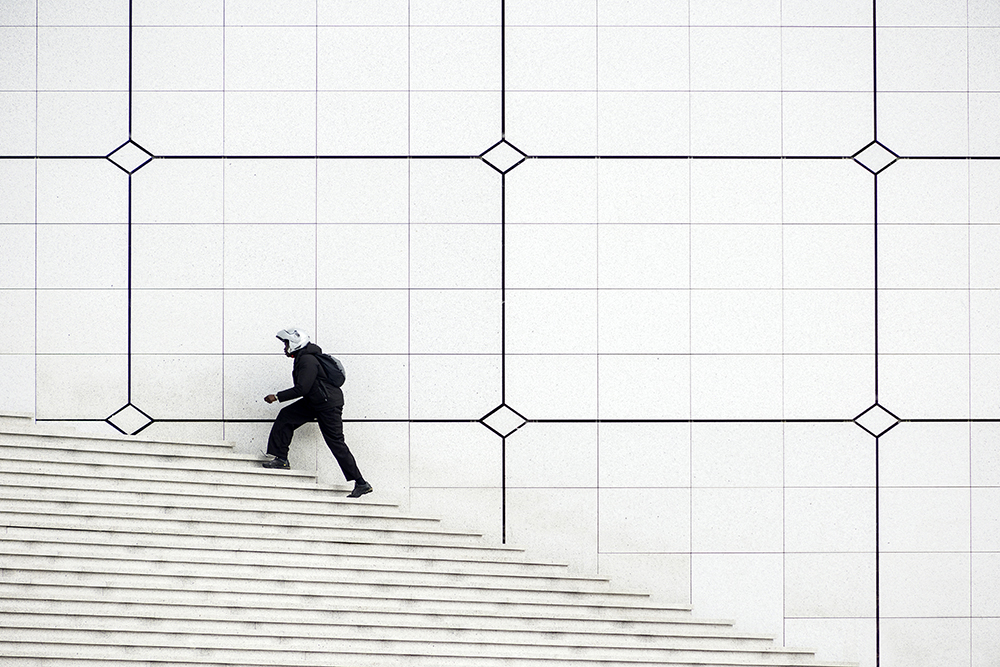
Imagen de un transeúnte subiendo las imponentes escaleras en un edificio de La Defense de Paris llevando un casco de moto y subiendo los escalones de tres en tres.
2. Me encanta entrevistar a arquitectos que también son fotógrafos porque creo firmemente que hay una clara relación entre ambas disciplinas. En tu caso, ¿Qué relaciones ves tú entre la arquitectura y la fotografía, y más concretamente, la fotografía de calle?
Pues yo también creo que hay clara relación entre Arquitectura y Fotografía. Para mi la Arquitectura es un arte, que genera emoción al que lo ve, al que lo habita, al que lo usa, y es parecido a la Fotografía en la que la mirada del fotógrafo intenta transmitir o trasladar un mensaje, una emoción o simplemente documentar lo que pasa a su alrededor.
Tanto en la Arquitectura como en la Fotografía de calle, existen elementos comunes como la luz y la sombra, la composición, la geometría, la escala, que tienes que manejar de forma diestra para poder obtener un resultado óptimo en tus obras. Mi fotografía de calle está estrechamente relacionada con la arquitectura, incluso a veces peco por la pulcritud de las líneas que aparecen, quitando quizás un poco de espontaneidad a las escenas.
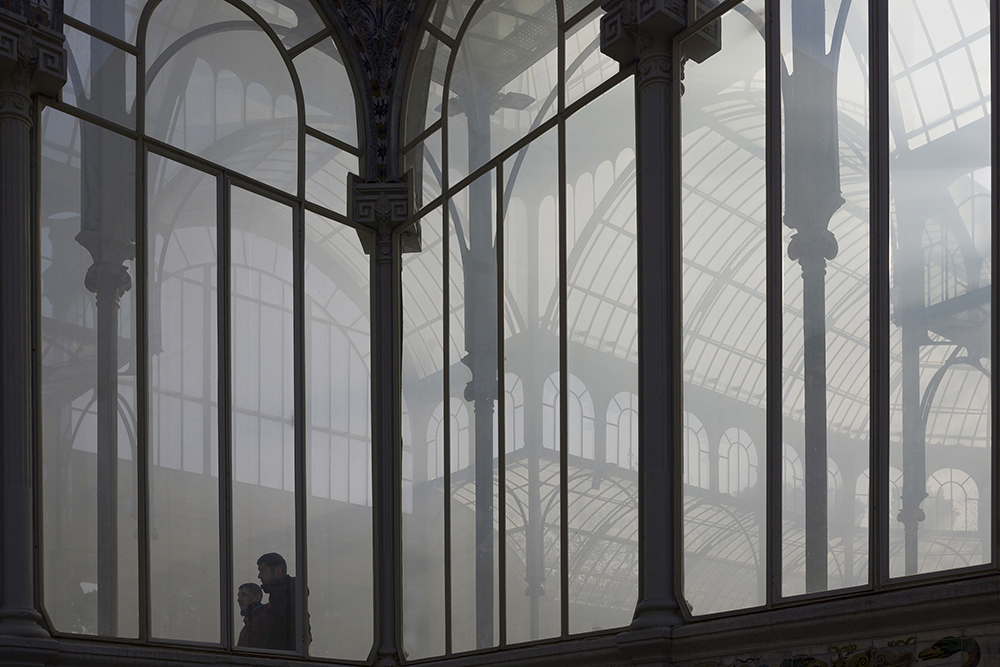
Imagen desde el exterior del Palacio de Cristal del Parque del Retiro de Madrid, que ofrece una perspectiva muy interesante de la estructura interior que es visitada por miles de personas al año y alberga exposiciones del CARS.
3. Observando tu página web y tu instagram, compruebo que no tienes, a mi entender, preferencia o predilección por un estilo o temática concreta al hacer fotografía, sino que, dicho en lenguaje coloquial, le das a muchos palos: calle, arquitectura, paisaje, etc. ¿a qué se debe, si es que hay una razón para ello?
No lo tengo muy claro, pero me aburre centrarme en un tema y estrujarlo hasta sacarle la última gota…Creo que me gusta explorar y, por otro lado, tengo la sensación que no soy lo suficientemente disciplinado para dedicarme a un solo tema…la prueba es que en alguna ocasión salgo a hacer fotos intentando focalizar mi mirada sobre algún aspecto en particular y me distraigo con facilidad con otras cosas.
Supongo que es más un defecto que una virtud, pero debo vivir con ello. Y a veces, no está tan mal, te llevas gratas sorpresas con el resultado de algunos trabajos que haces ocasionalmente.
4. Centrándonos más concretamente al objetivo de esta entrevista, ¿Qué entiendes tú por fotografía de calle?
La fotografía de calle para mí es una forma de vida, es una forma de observar y capturar el día a día que ocurre en las ciudades que habitas, que visitas, como un simple elemento más dentro de ellas y sin casi intervención en la escena, pero con una implicación máxima si quieres conseguir resultados decentes. Empecé a hacer Street sin saber muy bien qué era. Creo que poco a poco voy desarrollando ese sentido de instante especial, de punctum, de momento decisivo y único, y casi seguro irrepetible. Creo que es eso lo que engancha cuando fugazmente eres capaz de conseguir algo especial y quieres repetirlo tantas veces como puedas. Tu corazón late, la adrenalina aparece y supongo, que luego la dopamina y esas cosas que hacen que te sientas vivo. Se trata de una búsqueda constante y paciente, pero que no siempre tiene su recompensa.
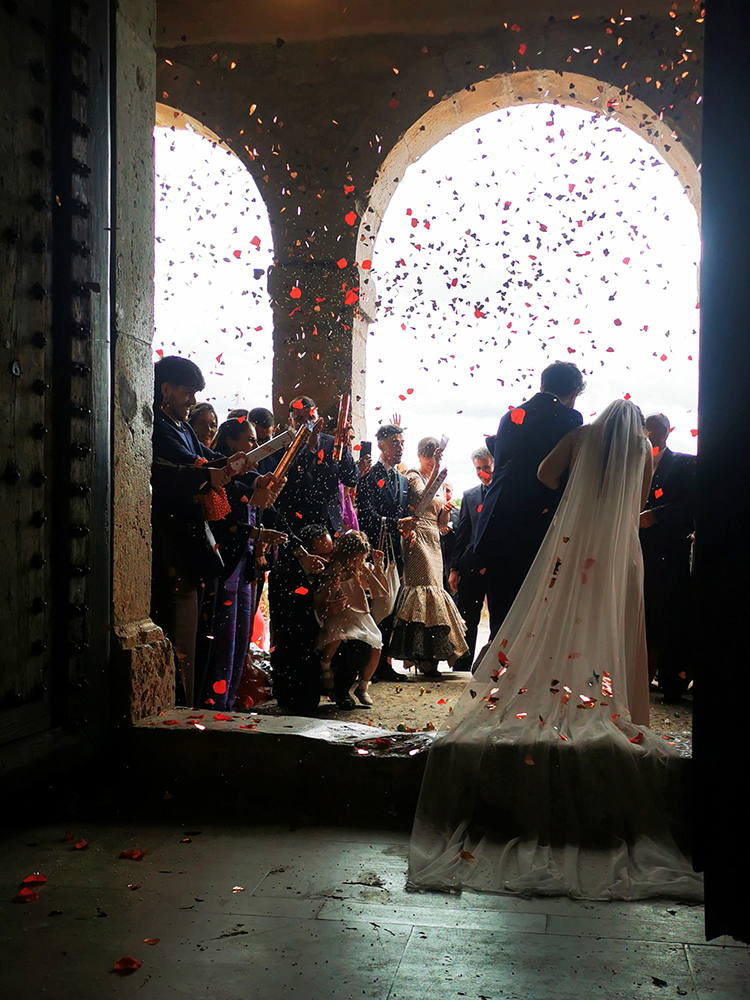
Esta instantánea fue tomada al salir de la Iglesia de Los Santos de la Humosa en la ceremonia de casamiento entre mi primo Pablo e Iziar, y fue premiada en la 4º Edición Global de los Huawei Xmage Awards 2024.
5. Utilizas simultáneamente cámara y móvil, sin aparentemente tener predilección por un aparato frente a otro, lo cual, personalmente, me atrae mucho. ¿Por qué el uso simultáneo de ambos dispositivos? y ¿Qué ventajas y desventajas le ves al uso de cada aparato cuando haces fotografía de calle?
Efectivamente mi producción suele estar al 50% entre cámara full frame y dispositivo móvil en la actualidad…Incluso soy capaz de retratar la misma escena si permanece lo suficiente con ambos dispositivos.
La cámara full frame sin espejo me aporta calidad sobre todo para poder “revelar” en postproducción, poder ajustar los parámetros de forma más exacta en cámara, principalmente en escenas de alta velocidad…, el dispositivo móvil me aporta versatilidad, rapidez y discreción… La comodidad de llevar en el bolsillo un dispositivo potente, con varias lentes y que capta de forma diferente a una cámara convencional la realidad es lo que ha hecho que mi flujo de trabajo se haya equilibrado últimamente.
Quizás para la fotografía de calle no tengo todavía una cámara Street apropiada. Es el próximo reto a conseguir, una cámara discreta y rápida que me permita acercarme a la escena y a las personas sin abrumarlas, intentando intervenir en lo que pasa lo menos posible.
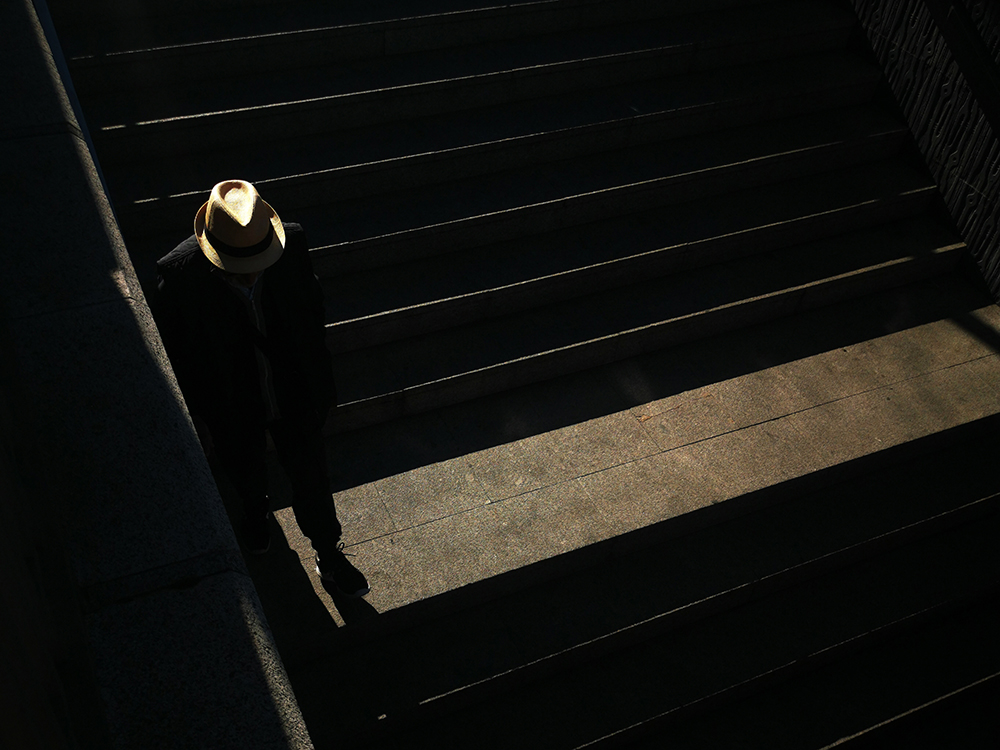
Esta toma fue realizada en 2023 en mi ciudad natal, Madrid. Estaba esperando en la boca del Metro de Banco de España a que bajara el sol y dibujara líneas de luz sobre los escalones, y a que apareciera alguien interesante para fotografiar… De repente, apareció un típico señor mayor madrileño con sombrero, iluminado frente a la sombra de los escalones.
El personaje principal parece irradiar una misteriosa energía, en una escena que experimenta con la luz y la sombra y la geometría de la arquitectura que le rodea.
Esta fotografía fue galardonada con el 1º premio del 19º Mira Mobile Prize en Oporto, en 2025.
6. ¿Cómo afrontas la calle cuando haces “Street”? O dicho de otra manera, ¿Qué buscas, qué te estimula, cuáles son tus objetivos, qué atrapa tu ojo, cuando haces “Street”?
A mi me estimula todo y eso no es bueno… si estoy tomando una cerveza con familiares o amigos, es un poco frustrante estar “viendo” fotos a tu alrededor y no poder “desconectar” del todo.
En cuanto al “Street”, busco la geometría en las formas, una luz especial, poder componer ya sea de forma más clásica o buscar composiciones creativas, creo que son las bases de mi fotografía de calle, lo que más estimula mi mirada fotográfica. Por otro lado, el elemento humano es imprescindible en mis capturas, sin el cual me siento un poco desnudo, sin demasiados argumentos con los que poder contar algo, aunque creo que también se puede.
En los últimos años estoy intentando capturar escenas que sean algo más narrativas, o escenas casuales que por llamativas, capten la atención, pero es un proceso en el que estoy en la actualidad metido y que lleva cierta práctica hasta que comienzas a ver resultados estables y consolidados.
Por último, tengo el objetivo de realizar fotografías de detalle de forma más consciente, me atrae la parte por el todo, detalles de una escena que por sí sola cuenten una historia sin necesidad de mostrar nada más.
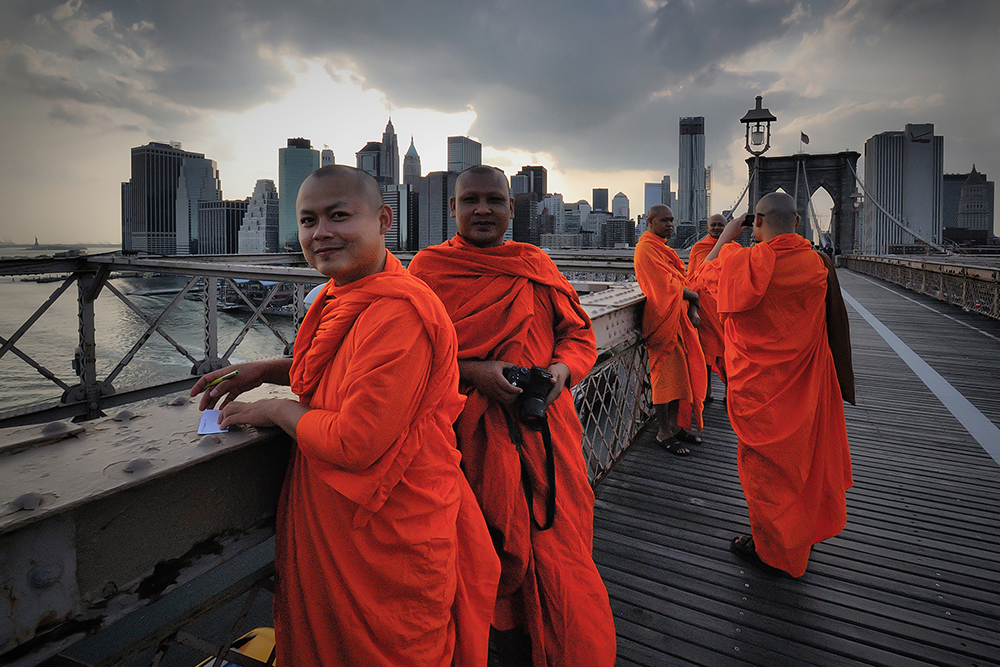
Esta imagen fue tomada en el puente de Brooklyn, en Nueva York. Mi mujer y yo estábamos visitando la ciudad que nunca duerme y acabábamos de ver ganar un partido de España contra Chile en el Mundial de Fútbol de Sudáfrica 2010. Paseando por el puente, nos encontramos con un grupo de monjes budistas y saqué mi cámara para obtener una toma de ellos. Éramos varias personas haciéndoles fotos por sus pintorescas túnicas, así que, una vez tomada la foto, y dado que la situación era un poco incómoda, me acerqué para charlar con ellos y ofrecerles la imagen. Woody, un monje budista tailandés, me atendió muy amablemente y accedió a darme su email… En ese momento, me retiré ligeramente y realicé esta toma, a la que le tengo mucho cariño.
Aunque técnicamente era difícil de hacer sin flash, esta fotografía me agrada por el momento, por la composición y por el color. Además, creo que cuenta una historia: la historia de unos monjes asiáticos del otro lado del planeta haciendo turismo en la ciudad del país occidental por excelencia. Fue publicada junto con un artículo titulado “La tarde que ganó La Roja” en el dominical del País Semanal, un diario de reconocido prestigio a nivel nacional.
7. Cuando haces fotografía de calle con el móvil, ¿editas también las fotos en el móvil, o las pasas al ordenador y las editas ahí?
Las instantáneas que capturo con el móvil siempre las edito directamente en el móvil, ya sea con el editor de serie que tiene el smartphone o con Snapseed. Raramente las paso al ordenador para editarlas a no ser que quiera cambiar su tamaño o resolución.
Es otra de las ventajas que le veo a la fotografía móvil, el poder compartir de forma rápida en redes sociales o con familiares y amigos.
8. Corrígeme si me equivoco, pero en mi opinión, eres muy activo en instagram, subiendo diariamente varias fotos a esta plataforma. Si me permites expresarlo así, ¿por qué esta “adicción” a instagram? ¿Qué te aporta esta plataforma, en detrimento de otras plataformas que se centran exclusivamente en la fotografía?
Tengo que decir que mi actividad varía, no he sido muy activo durante años y ahora, que parece que no sirve de mucho, he pasado a ser algo más activo. No te puedo dar una razón concreta de porqué utilizo Instagram, y porqué no utilizo otras, será seguramente por comodidad.
Simplemente he conocido gente interesante a través de los perfiles, se puede obtener cierto feedback de esa gente interesante, a veces hay alguien que se pone en contacto contigo a través de mensajes directos para solicitarte algo o simplemente hablarte de tus publicaciones y poco más…Si es por los likes, hace ya tiempo que lo hubiera dejado porque rara vez llego a los 50 en una publicación.
Adicionalmente, hay muchos concursos en los que participo que se desarrollan por IG y no en otras plataformas y, al final, todo esto hace que te focalices en una sola, aunque tengas cuentas en otras plataformas o redes que estén casi inactivas.
9. Te gusta también presentarte a concursos, con excelentes resultados, debo decir. ¿Por qué? ¿Qué buscas concursando tanto, si es que hay un objetivo concreto?
Bueno, en primer lugar, a mí me gusta competir en general, y por otro lado, es un estímulo que hace que mi producción fotográfica no baje en épocas de mucho trabajo y estrés en el campo de la Arquitectura.
Al final creo que buscas algo de reconocimiento, que tu trabajo pueda tener alguna repercusión, y también a nivel personal, desarrollar ciertas facetas artísticas y que tu hobbie no te cueste dinero.
Yo he aprendido mucho a través de los concursos, he enriquecido mi agudeza visual para detectar esos momentos especiales, he viajado gracias a los concursos y he conocido a bastante gente que ahora los considero amigos. Aunque he tenido resultados más que buenos, tengo la impresión de que no es una ciencia exacta ni mucho menos; me resulta excitante por un lado y frustrante por el otro, pero más o menos lo tengo ya asumido.
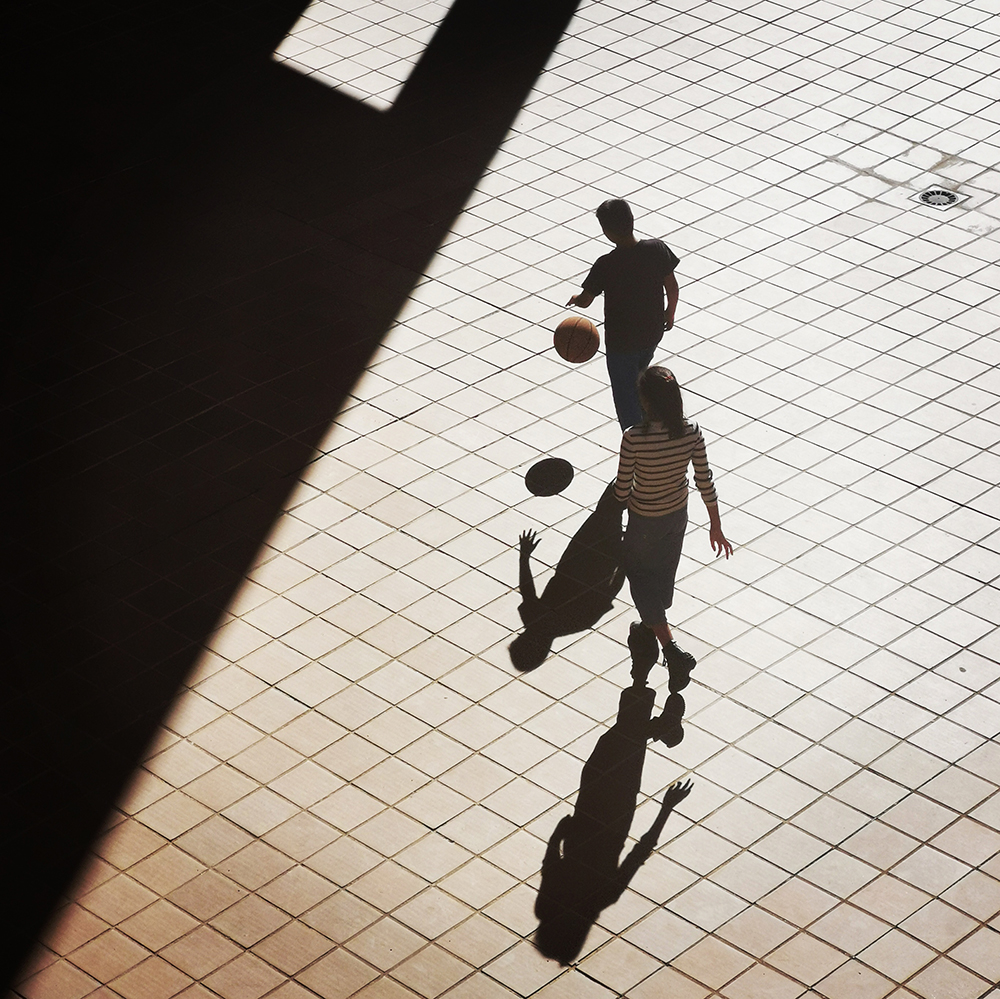
Para mí, la fotografía puede surgir en cualquier lugar, y este es un buen ejemplo. Un día había niños jugando en el interior del patio de la urbanización. Debido al alboroto que hacían, me asomé a la ventana de la habitación de mi hija y descubrí un escenario impactante, con el sol creando sombras tanto del propio edificio como sobre el pavimento. Solo tuve que coger el móvil y esperar unos segundos a que las figuras y sus sombras crearan magia.
Esta fotografía va a ser publicada en breve en The Guardian Saturday.
10. Sé que es un tópico en toda entrevista a fotógrafo, pero no puedo evitar hacértela, porque me interesa saber tu opinión, ¿Qué consejos, desde tu experiencia, le darías a aquellos que se inicien en la fotografía de calle?
Mi mejor consejo es que disfruten con la fotografía que elijan hacer. Los procesos creativos no siempre son sencillos, y a veces no encuentras el camino o se te hace muy cuesta arriba… De hecho, yo sigo en una búsqueda constante de hacia dónde ir.
Respecto a la fotografía de calle, la paciencia y la constancia son fundamentales para poder conseguir un resultado estable en el tiempo.
También creo que la formación y los referentes son importantes a la hora de desarrollar tu propio estilo, tanto en fotografía como en arquitectura. En mi caso, tengo muchos referentes fotográficos, tanto del pasado como actuales, y voy descubriendo nuevos casi cada día. Voy a enumerar algunos de ellos por orden de aparición en mi trayectoria fotográfica:
Joseph Hoflehner, Henri Cartier-Bresson, Robert Frack, Javier Arcenillas, Sebastiao Salgado, Ramón Masats, Gabriel Cualladó, Pau Buscató y muchos más, anteriores y por llegar… Además de toda la gente maravillosa e interesante que voy conociendo en el camino fotográfico, que se convierten en amigos o compañeros de viaje.
joseluismoralesmartin.com / @morales3arc / @morales3arcmovil
ENGLISH VERSION: INTERVIEW – LA CALLE ES NUESTRA COLLECTIVE: JOSE LUIS MORALES
All the interviews and short features I have done for the LCEN website have been with photographers who use only, or mainly, their mobile phones for their work as street photographers. This is once again the case with today’s interviewee, José Luis Morales. The difference is that José Luis, in addition to being an excellent photographer, is an architect by profession, like myself, which, for me, adds an extra layer of interest to his work.
José Luis and I have known each other for several years now. We’ve met a couple of times, but we stay in frequent contact via WhatsApp and Instagram. We are now two colleagues who share a passion for photography (including street photography) and architecture. I really wanted to interview him. Let’s get to know him and his photographic work a little better.
1. Tell us a bit about yourself and, most importantly, how you got into photography.
I am an architect born in Madrid and currently living in Las Rozas. Among my many passions, I love having a camera or a mobile device in my hands to capture whatever is happening around me. I love traveling, discovering special places and their people and traditions, although I admit I don’t like suffering while traveling—I’m a bit of a gourmet. Still, for a good photographic experience, I can make an exception.
During my childhood, I wasn’t particularly drawn to photography, although I did take family photos during holidays and family events. The camera would then stay in a drawer for the rest of the year. I think I didn’t really understand the camera’s settings, even though it was very basic, and the results frustrated me a bit, so it never fully hooked me.
Later, at university, while building scale models for design studio classes, photography became an essential tool to present project ideas on drawing boards. That marked a second period of interest. It was complicated, though, because the models were small and the lenses I had weren’t great. Combined with my limited technical knowledge, my interest in photography was put on hold once again. Still, the seed was growing, partly thanks to the education I was receiving during my studies. The real turning point came with the arrival of digital photography.
Between 2002 and 2006, my interest in travel photography—already developing in an analog way with my girlfriend and later wife, almost like a competition to see who took better photos—began to grow slowly but steadily. With the digital era, I started exploring photography in a self-taught way and finally began to understand what a camera could do. That journey has led me to who I am today, still learning new things every day, and hopefully never stopping.
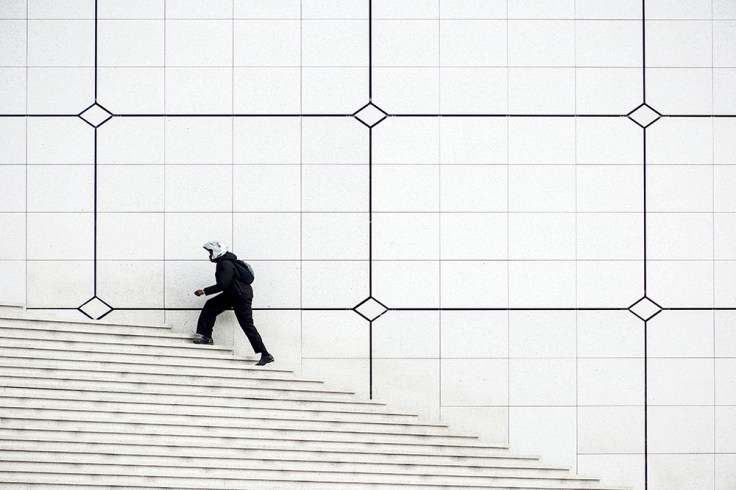
“Cold Cities,” 2025 (Canon R6 DSLR)
Image of a passerby climbing the imposing stairway of a building in La Défense, Paris, wearing a motorcycle helmet and taking the steps three at a time.
2. I love interviewing architects who are also photographers because I firmly believe there’s a clear relationship between both disciplines. In your case, what connections do you see between architecture and photography, and more specifically, street photography?
I also believe there’s a clear relationship between architecture and photography. To me, architecture is an art form that generates emotion in those who see it, inhabit it, or use it. Photography is similar in that the photographer’s gaze seeks to convey a message, an emotion, or simply to document what is happening around them.
Both architecture and street photography share common elements such as light and shadow, composition, geometry, and scale, which must be skillfully handled to achieve optimal results. My street photography is closely linked to architecture; sometimes I may even lean too much toward clean lines, which perhaps takes away a bit of spontaneity from the scenes.
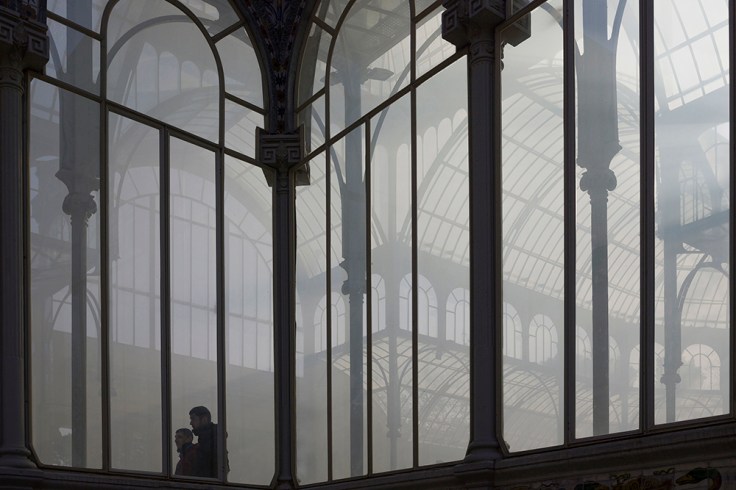
An image taken from outside the Crystal Palace in Madrid’s Retiro Park, offering an interesting perspective of its interior structure, which is visited by thousands of people each year and hosts exhibitions by the Reina Sofía Museum (MNCARS).
3. Looking at your website and Instagram, I get the sense that you don’t have a clear preference for a specific style or theme. Instead, you explore many genres: street, architecture, landscape, etc. Why is that?
I’m not entirely sure, but I get bored focusing on a single subject and squeezing it dry. I think I enjoy exploring, and on the other hand, I feel I’m not disciplined enough to devote myself to just one theme. Proof of this is that sometimes I go out with the intention of focusing on a specific aspect, but I easily get distracted by other things.
I suppose it’s more of a flaw than a virtue, but I have to live with it. And sometimes it’s not so bad—you end up with pleasant surprises from work you do only occasionally.
4. Focusing more specifically on the purpose of this interview, what does street photography mean to you?
For me, street photography is a way of life. It’s a way of observing and capturing everyday life in the cities you live in or visit, as just another element within them, with almost no intervention in the scene, yet with maximum involvement if you want to achieve decent results.
I started doing street photography without really knowing what it was. Little by little, I believe I’m developing a sense of that special instant—the punctum, the decisive and unique moment, almost certainly unrepeatable. That’s what hooks you: fleetingly capturing something special and wanting to repeat it as many times as possible. Your heart races, adrenaline kicks in, and later comes the dopamine—those things that make you feel alive. It’s a constant and patient search, though not always rewarded.
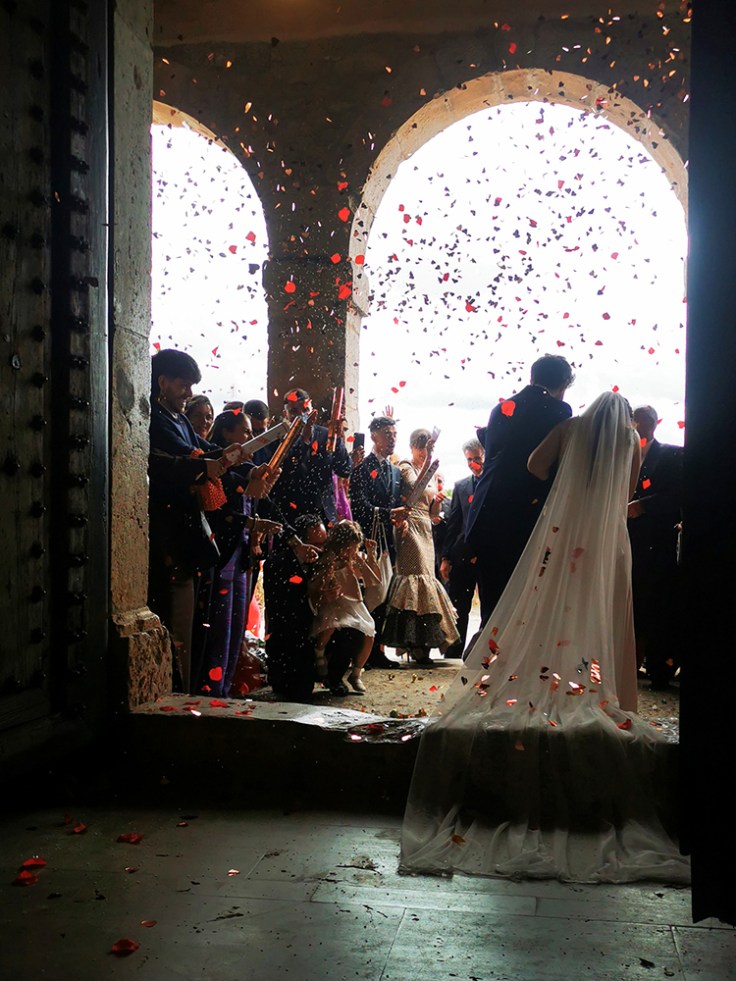
This snapshot was taken as we exited the church in Los Santos de la Humosa after the wedding ceremony of my cousin Pablo and Iziar. It was awarded at the 4th Global Edition of the Huawei XMAGE Awards 2024.
5. You use both a camera and a smartphone simultaneously, without an apparent preference for one over the other, which I personally find very appealing. Why do you use both, and what are the advantages and disadvantages of each for street photography?
Indeed, my current output is split roughly 50/50 between a full-frame camera and a mobile device. I’m even capable of photographing the same scene with both if it lasts long enough.
The mirrorless full-frame camera gives me quality, especially for post-processing and precise in-camera settings, particularly in high-speed scenes. The mobile device offers versatility, speed, and discretion. The convenience of carrying a powerful device in your pocket—with multiple lenses and a different way of capturing reality compared to a conventional camera—has balanced my workflow lately.
Perhaps I still don’t have the ideal street camera. That’s my next challenge: a discreet and fast camera that allows me to get close to scenes and people without overwhelming them, intervening as little as possible.
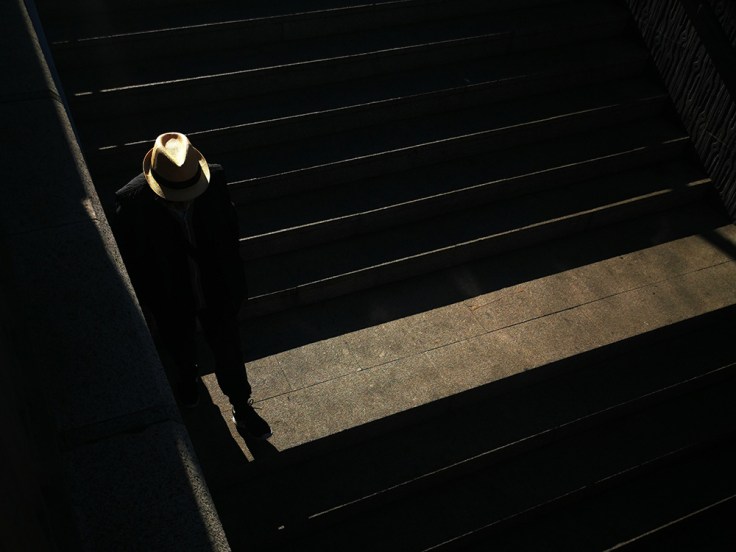
This photograph was taken in 2023 in my hometown, Madrid. I was waiting at the Banco de España metro entrance for the sun to set and draw lines of light across the steps, and for someone interesting to appear. Suddenly, a typical elderly Madrilenian man wearing a hat appeared, illuminated against the shadow of the stairs.
The main character seems to radiate a mysterious energy in a scene that plays with light, shadow, and architectural geometry. This photograph won first prize at the 19th Mira Mobile Prize in Porto in 2025.
6. How do you approach the street when you’re shooting street photography? In other words, what do you look for, what stimulates you, and what catches your eye?
Everything stimulates me—and that’s not necessarily good. If I’m having a beer with family or friends, it can be frustrating to be “seeing” photos everywhere and not being able to fully switch off.
In street photography, I look for geometry in forms, special light, and composition—whether more classic or creatively experimental. These are the foundations of my street photography and what most stimulates my photographic eye. The human element is essential in my images; without it, I feel somewhat exposed, lacking strong arguments to tell a story—although I believe it can still be done.
In recent years, I’ve been trying to capture more narrative scenes or casual moments that stand out and catch attention. It’s a process I’m currently immersed in, and it takes practice before you start seeing consistent and solid results.
Finally, I aim to consciously work more on detail photography. I’m attracted to the part representing the whole—details of a scene that tell a story on their own without showing anything else.
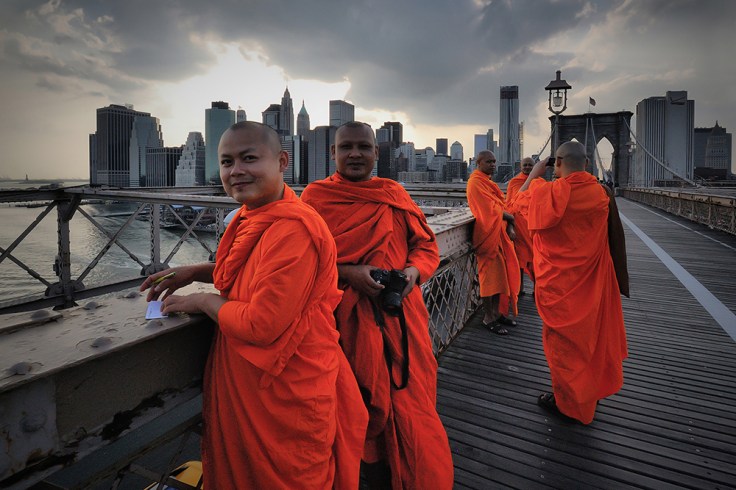
This image was taken on the Brooklyn Bridge in New York. My wife and I were visiting the city that never sleeps, having just watched Spain defeat Chile in the 2010 South Africa World Cup. While walking across the bridge, we came across a group of Buddhist monks and I took out my camera to photograph them.
Several people were photographing them because of their picturesque robes, so after taking the photo—and given the slightly awkward situation—I approached them to chat and offer them the image. Woody, a Thai Buddhist monk, kindly spoke with me and agreed to give me his email. At that moment, I stepped back slightly and took this photograph, which I’m very fond of.
Although it was technically difficult to take without flash, I like the moment, the composition, and the color. I also believe it tells a story: Asian monks from the other side of the planet sightseeing in the quintessential Western city. It was published alongside an article titled “The Afternoon La Roja Won” in El País Semanal, a nationally renowned newspaper supplement.
7. When you shoot street photography with your phone, do you also edit the photos on the phone, or do you transfer them to a computer?
I always edit mobile photos directly on the phone, either using the built-in editor or Snapseed. I rarely transfer them to a computer unless I want to change their size or resolution.
That’s another advantage of mobile photography: the ability to quickly share images on social media or with family and friends.
8. Correct me if I’m wrong, but in my opinion, you’re very active on Instagram, posting several photos daily. If I may put it this way, why this “addiction” to Instagram? What does this platform give you compared to others focused exclusively on photography?
I should say that my activity varies. I wasn’t very active for years, and now—when it seems to matter less—I’ve become more active. I can’t give a concrete reason why I use Instagram instead of others; it’s probably convenience.
I’ve met interesting people through profiles, received feedback from them, and sometimes someone reaches out via direct message to ask for something or comment on my work. If it were about likes, I would have quit long ago—I rarely reach 50 likes per post.
Additionally, many contests I participate in take place on Instagram rather than other platforms, which ultimately makes you focus on one, even if you have accounts elsewhere that are nearly inactive.
9. You also enjoy entering photography contests, with excellent results, I must say. Why? What are you looking for by competing so much?
First of all, I enjoy competition in general. It’s also a stimulus that prevents my photographic output from declining during periods of intense work and stress in architecture.
Ultimately, I think you’re looking for some recognition, for your work to have an impact, and on a personal level, to develop artistic aspects while ensuring your hobby doesn’t cost you money.
I’ve learned a lot through contests, sharpened my visual acuity for detecting special moments, traveled thanks to them, and met many people I now consider friends. Although I’ve had very good results, I feel it’s far from an exact science. It’s exciting on one hand and frustrating on the other, but I’ve more or less come to terms with that.
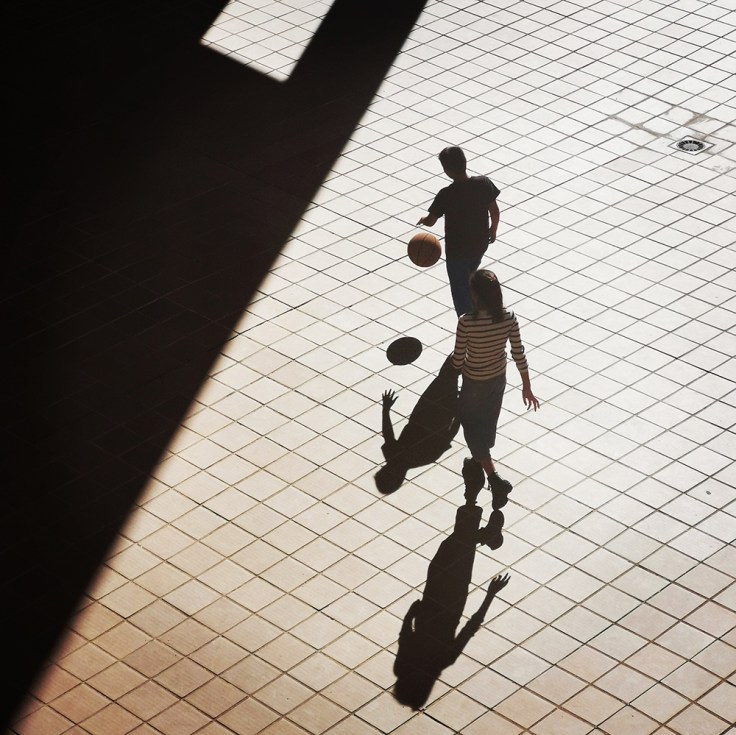
For me, photography can emerge anywhere, and this is a good example. One day, children were playing noisily in the courtyard of our residential complex. Because of the commotion, I leaned out of my daughter’s bedroom window and discovered a striking scene, with the sun casting shadows from the building and across the pavement.
10. I know it’s a classic interview question for photographers, but I can’t avoid asking it: what advice, based on your experience, would you give to those starting out in street photography?
My best advice is to enjoy whatever kind of photography you choose to pursue. Creative processes aren’t always easy, and sometimes you can’t find your path or it feels overwhelmingly difficult. In fact, I’m still constantly searching for where to go.
In street photography, patience and consistency are essential for achieving stable results over time. Training and references are also important when developing your own style, both in photography and architecture. I have many photographic references, past and present, and I discover new ones almost daily.
Some of them, in chronological order throughout my journey, are: Joseph Hoflehner, Henri Cartier-Bresson, Robert Frank, Javier Arcenillas, Sebastião Salgado, Ramón Masats, Gabriel Cualladó, Pau Buscató, and many more—past and yet to come. And of course, all the wonderful and interesting people I meet along the photographic path, who become friends or travel companions.
joseluismoralesmartin.com / @morales3arc / @morales3arcmovil


 La Calle es Nuestra
Deja un comentario